
How to integrate shipping into your ERP system
Enterprise resource planning (ERP) systems are where organizations go to agree on the truth. Orders, inventory, financials, and reporting all converge in one place, giving teams confidence that the business is operating on consistent information.
As companies grow, ERPs bring structure to complexity. Finance relies on them for accuracy. IT depends on them for stability. Operations trusts them to keep the business running in sync across teams and locations.
Shipping introduces a different dynamic. While most ERPs include native shipping functionality, those tools are designed to move orders through a process, not to adapt continuously to changing carrier rules, costs, and service expectations. That distinction becomes more noticeable as shipping volume increases and fulfillment decisions become less predictable.
Many businesses reach a point where basic ERP shipping options no longer keep pace. Instead of forcing increasingly complex shipping logic into the ERP, teams extend it with systems designed to handle carrier selection, rate comparison, packaging decisions, and delivery visibility at scale.
The goal is to preserve the strengths of your ERP and minimize workflow disruption while upgrading your shipping strategy from a basic function into a flexible, multi-carrier execution layer.
Limits of native ERP shipping
Most ERPs come equipped with native shipping functionality designed to support basic execution. For teams shipping predictable volumes through a small, stable set of services, this may be enough to get orders out the door.
The limitations surface gradually. As volumes grow, carrier pricing shifts, and delivery requirements become more nuanced, shipping decisions stop being routine. What once felt sufficient begins to require exceptions, manual checks, and workarounds that live outside the ERP.
Release timelines
Shipping conditions change in real time. Rates adjust. Services are added or retired. Packaging rules evolve as cost structures shift.
ERP systems change deliberately. Updates move through planning cycles, testing, approvals, and deployment windows. When shipping logic lives inside that process, even minor adjustments can take weeks to implement.
The impact is not just delay. Teams miss opportunities to control costs or improve service because the system cannot move at the same pace as the shipping environment.
Carrier complexity
Consider the common scenario where an order appears lightweight and close enough to qualify for a low-cost service based on ERP routing rules. Later, the carrier invoice reflects a higher charge driven by dimensional weight, address type, or a service adjustment that was never captured in the ERP logic.
Carrier pricing and service rules are not fixed. They vary by zone, package characteristics, address type, service level, and delivery commitment, and they change regularly.
ERP shipping setups rely on predefined mappings. As carrier logic becomes more nuanced, teams end up managing exceptions manually just to keep shipments moving.
Less granular insights
ERPs are built to summarize outcomes. Shipping operations generate signals.
Every shipment produces timestamps, scans, delivery attempts, service failures, and exceptions that explain why something happened, not just what it cost. When that detail is reduced to a few financial fields, teams lose the ability to trace issues back to their source.
Reporting remains accurate, but insight disappears. Questions about delays, service performance, or recurring problems become harder to answer with confidence.
Designing an ERP shipping integration framework
Designing how shipping integrates with your ERP is a structural decision about where responsibility lives across systems.
A clear framework helps teams avoid unnecessary ERP customization while giving shipping operations the flexibility to adapt as volume, carriers, and service requirements change. When boundaries are defined upfront, integrations become easier to maintain and more resilient over time.
Let the ERP remain the system of record
The ERP should remain the source of truth for orders, customers, and financials. A shipping integration should support that role by feeding in accurate shipment data where it’s needed, without requiring teams to rework existing processes.
This separation helps protect the ERP from unnecessary complexity while preserving stability as shipping operations evolve.
Add a shipping execution layer
A shipping execution layer is the system responsible for making real-time shipping decisions once an order is ready to move. It sits between the ERP and the carriers, translating order data into carrier selections, packaging decisions, labels, and delivery updates.
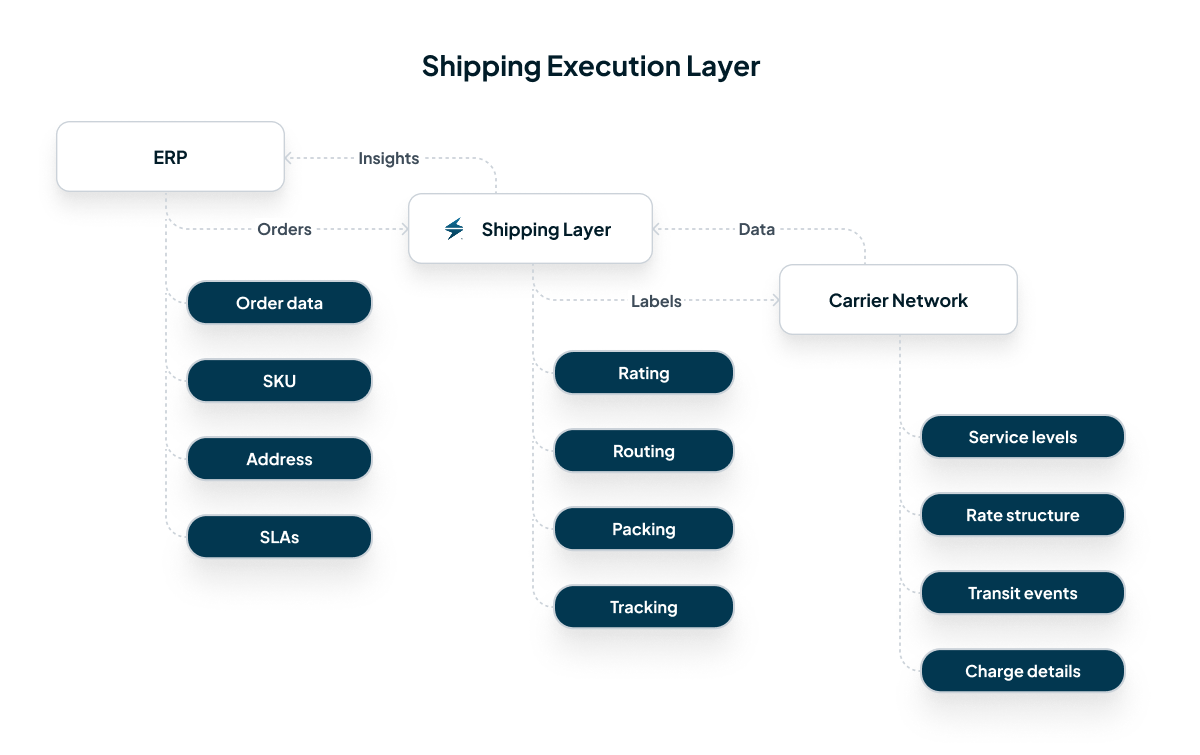
This layer handles the work that changes most often: comparing services, applying business rules, validating addresses, generating labels, and tracking shipments as conditions evolve. Because it operates outside the ERP, those decisions can be adjusted quickly without introducing risk into core financial or order systems.
In practice, the ERP sends the order. The execution layer determines how it ships. The results flow back to the ERP so reporting, billing, and downstream workflows stay aligned.
Sync shipping data back to finance
For finance teams, shipping does not end when a label is created. In many businesses, it ends when delivery is confirmed and a waiting period has passed. Marketplaces and payment providers often tie revenue release to proof of delivery, followed by a defined settlement window, creating what finance teams manage as deferred transactions.
When shipping data arrives late, incomplete, or inconsistently across carriers, payout timing becomes harder to forecast. Deferred transactions remain open longer than expected, reconciliation slows, and close cycles become reactive instead of planned.
A strong shipping integration ensures delivery confirmation, final costs, and exceptions flow back into the ERP as they occur. When those signals are reliable, finance teams can project cash flow with confidence and operations avoid downstream cleanup that drags on margins and time.
ERP shipping integration strategies
A team shipping from one location with consistent volume solves a very different problem than a team routing orders across multiple warehouses with varying service expectations. The way shipping is integrated into the ERP shapes how each of those teams operates day to day.
Some integration approaches prioritize simplicity. Others prioritize flexibility. The right choice depends on how much variation the fulfillment workflow needs to absorb as the business scales.
ERP-embedded shipping modules
ERP-embedded shipping modules keep execution tightly coupled to the ERP. Orders, shipping logic, and fulfillment rules all live in one system, which can feel simpler early on.
This approach works best when shipping workflows are stable and change infrequently. As requirements evolve, however, adjustments often require configuration changes, testing, and coordination with IT. Over time, the convenience of a single system gives way to slower decision-making and limited flexibility.
Middleware and integration layers
Middleware platforms can bridge ERPs and external shipping systems when shipping decisions depend on inputs from multiple systems rather than a single source of truth.
While flexible, this approach can introduce additional layers to manage and monitor. Ownership of shipping logic may still be unclear between systems.
Dedicated shipping platform API
A dedicated, multi-carrier shipping platform connected to the ERP via API takes responsibility for the shipping decisions that change most often. The ERP sends the order. The shipping platform determines how it will ship based on cost, service, and operational rules, then returns the outcome for reporting and billing.
This separation allows shipping logic to evolve without destabilizing core systems, giving teams room to scale without rebuilding workflows every time conditions change.
Choosing an ERP shipping integration
Evaluating an ERP shipping integration involves looking beyond initial setup to see how shipping rules change, exceptions are handled, and data moves once the system is under real load.
No-code routing rules
Shipping conditions change daily. Integration should allow operations teams to adjust rules without opening ERP tickets or waiting for development cycles.
This reduces friction and keeps fulfillment aligned with real-world constraints.
Carrier flexibility
Adding a new carrier or service should not require rethinking how orders are structured inside the ERP. In many environments, carrier-specific logic becomes embedded in order fields, service codes, or downstream workflows, making even small changes disruptive.
A strong shipping integration keeps carrier complexity outside the ERP. New services can be added, rules adjusted, and routing logic updated without touching core order data. This allows teams to adapt their carrier strategy without introducing risk into reporting, billing, or fulfillment workflows that depend on stable ERP data.
Clean data
Finance teams need confidence in shipping data. Costs, adjustments, and delivery confirmation must be traceable and consistent.
Integration should support auditability without overwhelming the ERP with unnecessary detail.
Benefits of an ERP shipping integration
When shipping is integrated thoughtfully into your ERP, the benefits extend beyond cost savings. Clear system boundaries reduce friction across teams and allow fulfillment operations to respond faster without destabilizing core systems.
Faster response to carrier changes
When shipping logic lives outside the ERP, teams can respond quickly to pricing updates, service shifts, and network changes.
The ERP remains stable while execution adapts.
Fewer handoffs across teams
When system roles are clearly defined, fewer decisions get stuck in the middle. Shipping teams can adjust logic without waiting on ERP changes, IT avoids being pulled into day-to-day fulfillment questions, and finance works from data it trusts.
Integration stops slowing teams down and starts supporting the way work actually happens.
Better visibility without noise
Visibility becomes a problem when teams are flooded with data but still lack answers. Shipping systems generate thousands of events, but not all of them help explain performance or guide decisions.
A well-designed integration captures detailed shipping activity while surfacing only what matters upstream. Leaders can see where costs, delays, or service issues are trending without digging through raw scans or exception logs, and teams stay focused on execution instead of reporting cleanup.
Closing thoughts
Integrating shipping into your ERP system is about technology and design. As fulfillment complexity grows, the goal is not to push more logic into core systems, but to make sure each part of the stack is responsible for the work it can handle best.
When the ERP remains the system of record, shipping decisions live in an execution layer built to adapt, and results flow back cleanly into finance and reporting, operations gain speed without sacrificing control. The stack stays resilient as volume, locations, and service expectations change.
That separation is what allows fulfillment to scale without constant rework, keeping core systems stable while execution evolves.




.svg)
.svg)
.avif)

.svg)
.avif)